
Always a maximum of 1% fee!
1 Percent Pool is well known for high performance and great rewards.
We’re active Mithril signers and will run Midnight validators for all pools!
Our Tickers: 1PCT and 1PCT[0-9]
(v1, v2 and v3 in description)
Read our FAQ for a lot more info about staking and 1 Percent Pool.
Ok, How do I stake with you?
In order to stake your ADA, you first need a wallet. The official wallets are Daedalus and Yoroi.
Daedalus is the most secure of the two, and it’s a full node wallet. This means that it downloads the whole chain, and validates every block.
Yoroi is available as a browser plugin, and as a mobile app. It’s a light wallet, which means it relies on a third-party to validate the chain.
We currently recommend using the Daedalus wallet. It’s available here: https://daedaluswallet.io
Once you have Daedalus or Yoroi installed, you need to create your wallet. You will be guided through this inside the program. Remember to write down your 24 recovery words and keep them safe! If you’re using Daedalus, it will now download and verify the blockchain.
You should now send all your ADA to your wallet. You should look for the receiving addresses associated with your wallet, and simply select one of them. When your ADA is transferred, you click the following symbol to go to the Delegation Center (Daedalus).
You then need to click on the Stake Pools tab, and write “1 Percent Pool” in the search field.
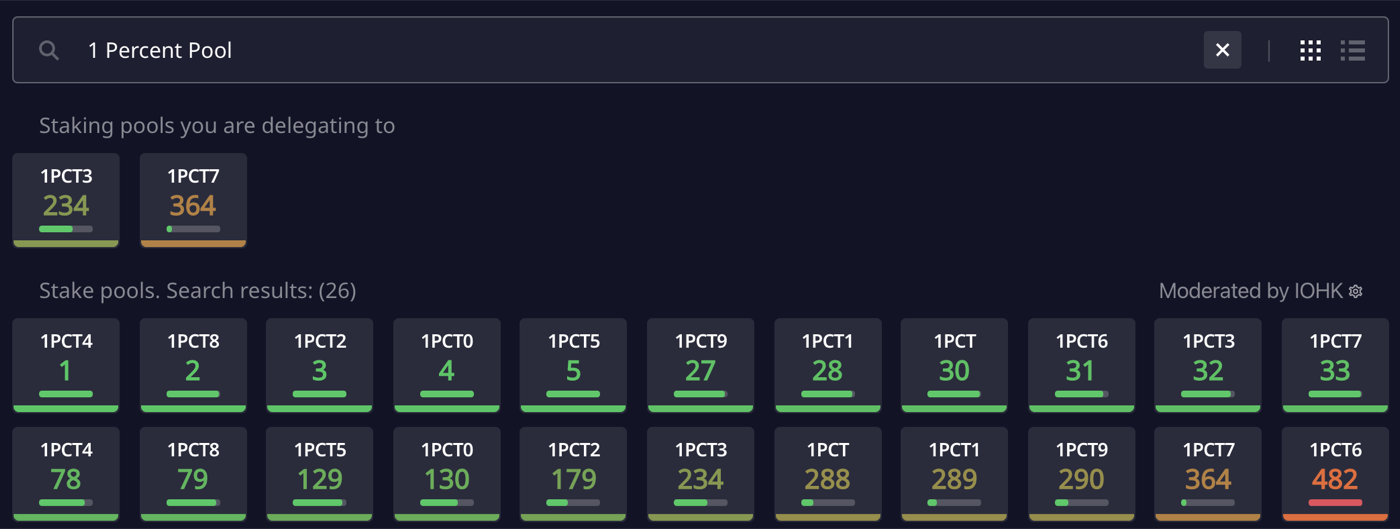
All 1PCT pools will now be shown. Simply click on the one with the lowest saturation (least filled bar) and then click “Delegate to this pool”.
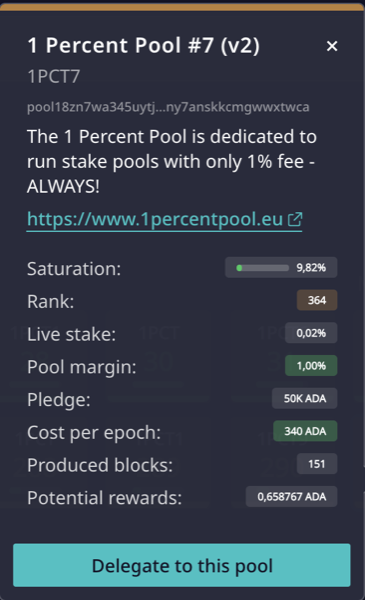
Now you simply follow the on-screen guide, that will take you through the rest of the delegation
Quick facts about staking in 1 Percent Pool
- Your ADA is never locked. You can always send it somewhere else.
- Your ADA stays in your wallet, fully under your own control.
- You do not risk your ADA by staking it.
- The protocol charges a 2 ADA stake key deposit the first time you delegate your ADA. This is the same for all pools.
- It takes 3-4 epochs for your first rewards to show up. That is 15-20 days. This is the same for all pools.
- After the initial 3-4 epochs, you will receive your rewards every epoch (5 days).
- You can freely change your delegation to another 1PCT pool. You will still get rewards every epoch if you change the pool.
- Your rewards are automatically staked as well. There is no need to withdraw rewards every epoch.
- You can simply add more ada to your wallet, and it will automatically be staked as well.
- Rewards amount will naturally fluctuate from epoch to epoch. It’s part of how the protocol is built, and it’s the same for all pools.
Pool parameters
All pools have a maximum of 1% fee – as they ALWAYS will!
All the 1PCT pools have 50.000 ADA pledged to them.
Rewards Example
If the total pool rewards for an epoch is 50.000 ADA, we first subtract 340 ADA as the pool cost. That leaves 49.660 ADA as rewards.
Based on these 49.660 ADA, the pool takes 1% (496,6 ADA) and the rest of the rewards (49.163,4 ADA) are then distributed to the delegators.
The total pool rewards for an epoch depends on the saturation level of the pool.
What is saturation?
Once a pool is fully saturated, you can still delegate to it, but it will not earn more rewards for it. The rewards will simply be shared between more delegators, hence giving you less rewards. Always delegate to the 1PCT pool with the lowest saturation.

More than 100,000
Blocks Made

28
1PCT pools running

100,0%
Uptime of pools so far

Most Rewards
Visit PoolTool.io Rewards Data
Why Select Us?
We understand your requirement and provide the best pools

High
Rewards
We strive to pay out the highest amount of rewards every epoch, which is why our fee is just 1%.

Full
Control
The stake pool cluster is securely setup, is fully automated and monitored 24/7.

Perfect
Scaling
Whenever the needs of running the Cardano stake pools changes, our setup will scale with the requirements.

Follows
Market
1 Percent Pool will always adjust the fee to stay competitive the market, and will go below 1% when needed. But always max 1%!

Always
Online
There are backup servers always standing by and ready to automatically take over, in case anything happens to the primary.

Very Secure
Our team has a top grade security setup in place, and all keys are stored in a secure facility, where no single person has all the required keys to enter.
Why should I select 1 Percent Pool?
1 Percent Pool was started in the beginning of the ITN, and has always been a top performing pool. We have over 18 months of proven reliability, and our team is located on 3 continents in order to provide max performance.
The concept is very simple: We provide best-in-class stake pool performance at a very good price point, and with high security operations.
Alternatively, if you choose a bad pool, many things can go wrong. The pool could fail, blocks be missed or it could completely go out of business. This means missing out on your staking rewards. The operator could increase the fees without you noticing, which means less rewards for you.
With 1 Percent Pool you can just set-it-and-forget-it. When you come back 12 months from now, all your rewards will be there waiting for you
Who are you?
Part of the security setup of 1 Percent Pool is staying anonymous. It’s much harder to attack someone, when you don’t know who they are.
We believe in free markets, decentralization and meritocracy. Ie: trusting the code — and not our identities.
Moreover, with a global team distributed on 3 continents, our ability to ensure uptime 24/7 sets us apart from smaller pools.
Ever since 2017, we’ve had an immense love for Cardano. What the project is achieving is very inspiring and worth building for.
Consequently, after working with advisors, we realized that helping the community can be achieved – while still keeping our operational security in place.
What is 'The ITN'?
ITN stands for Incenticized Test Net. It was 6 months of test net for Shelley, that was designed to test the game theory and incentive scheme. It started in December 2019. Many pools operators gained valuable experience in running a pool there, and established a reputation. The rewards from the test net were transferred to the main net, which made the test net incentivized – you earned real money from staking on the test net.
Why should I not select a 0% pool?
It sounds tempting to go for the lowest possible fee, but just like very cheap items on eBay, it’s rarely worth it.
In order for a stake pool to generate the maximum rewards over time, you need a professional and sophisticated setup. You need to make sure that the pools are highly connected to the network, that the hardware is adequate, that the internet connection is optimal, that the software is configured correctly and that the pool software is updated frequently. You need to build redundancy and automation, to have multiple internet connections, to have UPS backup power for the hardware and protect against attacks. You need a high level of automation and monitoring, to always keep the pools running perfectly, and in case of any breakdown, have a backup server standing by, that will automatically take over.
The income from a 0% pool is simply not enough to cover the expense of the above mentioned setup. For this reason, the 0% pools do not have this kind of setup, but instead run a much simpler operation. This means that they will perform worse over time, and hence pay less rewards. If you do the math, a 0% pool will give you worse rewards, even though it looks better on paper.
You risk having the pool operator raise the fees after they’ve attracted enough stake, or having the pool simply shut down because it’s not profitable. You don’t want to constantly have to check if the pool is still at 0% fee and still running, and risk staking to a dead pool or suddenly paying a much higher fee.
Pools with 0% fee are furthermore not incentivised to perform their best. The operator only makes money from the first block each epoch, and he then has no incentive to keep the pools performing well. There is no reason for him to make sure the rewards are at the absolute max, since it means extra costs for him, but no extra income. A pool with 1% fee has a great incentive to make sure the pools are always at their very max performance, and is willing to invest in it.
How many pools do you run?
1 Percent Pool is operating 28 pools in total. The tickers are 1PCT, 1PCT0, 1PCT1, 1PCT2, 1PCT3, 1PCT4, 1PCT5, 1PCT6, 1PCT7, 1PCT8 and 1PCT9.
There are a v1, v2 and v3 of each of these tickers.
Since you cannot own a ticker in a decentralised network, it’s possible for anyone to try and imitate the 1PCT brand. These attempts are usually quickly filtered in the metadata services. You can verify that the pools are authentic 1 Percent Pools by comparing the pool id from our pool list with the pool id inside Daedalus / Yoroi / AdaLite.
How and why did 1 Percent Pool start?
Cardano does so many things right, and is built on a solid foundation of research and scientific rigor. It’s fantastic when it comes to hard science, but it’s different when it comes to soft science. You can not create a mathematical proof when it comes to the game theory that shapes the human incentives for actions. Since Cardano is highly dependent on delegators acting rationally, this becomes one of the key risk areas for the survival of Cardano.
For Cardano to stay secure, we need:
– Informed delegators who knows about the concepts of fee, saturation, rewards, pledge and so forth.
– Rational delegators whose actions you can mostly predict, based on human nature. You can only have this, if they are informed.
– Protocol parameters that favour true decentralisation, and helps protect against Sybil attacks.
Since 2017, I have personally been most worried about the game theory around the decentralisation of the protocol. What would stop an entity from creating 1000 pools, get a majority of the stake by having no fees at all, and then start censoring the network? Since this, in my eyes, was the greatest threat to the project, it had to be given more focus.
When the ITN launched, I set out to test how delegators would react to an entity that openly created a large number of pools with very low fees. Since it was a test net, there would be no major harm to the network, but there would be immense learnings and opportunities to adjust the game theory model to secure the network properly. In the beginning, I simply acted like any smart Sybil attacker would do, if they tried to gain a majority of the stake. The first 11 pools were filled within weeks.
At the time, the Cardano Foundation was the gate keepers of the tickers, and had to approve a ticker in order for it to show up in Daedalus. When I tried to further test the vulnerability of the network, I was made aware of that the ITN was not tuned for Sybil attack resistance at all, which defeated the whole purpose of trying. I couldn’t perform an accurate test, because none of it was implemented. Hence I dropped the idea of trying to accumulate more stake, and focused on the performance of the pools instead.
The experiment did show how delegators could easily be attracted by low fees, but there is another major factor to look at, before judging the experiment. At the beginning of the ITN, the software was very shaky, and often failed. It was being built as a whole separate codebase, that allowed for quick iterations and development, so we could test the incentive schemes before main net. This meant that it was far from a level playing field for the operators. The first weeks and months were all about writing smart scripts to restart the software at the right times, to make sure it could actually make a block once it was time. 1 Percent Pool had a huge edge here, as I had figured out a number of rules that would make it perform very well, despite all the bugs. It involved a lot of monitoring, restarting each node 15 minutes before a block, a “private” bootstrap cluster to make the software start quickly and much, much more.
Since 1 Percent Pool was one of the very few great performing pools in the beginning, it was very natural that delegators rushed into the pools. The same would have happened if the fees were at 5%. For this reason, the test was not really accurate at all. Thankfully, the software we have on main net now is very stable and it’s (almost) a completely level playing field. It didn’t make sense to share the restart scripts with the community at the time, since it would work against the Sybil experiment, and once the experiment was dropped, many of the bugs had been ironed out. I did however share an article about how to improve the bootstrap time for the nodes and optimise the performance, which can be found here.
1 Percent Pool is now no longer an experiment, but an active protector of the protocol. It makes it much harder for a bad actor to try and perform a Sybil attack, and in these early days, we make sure that a lot of the stake is secure with a good actor. Once we see a higher number of reputable pools in the months and years to come, the network will be less at risk.
The focus of the pool, apart from best-in-class performance and low fees, is to study and prevent the possibility of Sybil attacks. We’re working with IOG/IOHK on this issue and sharing ideas, in order to further harden the resistance of such attacks. This is our way of contributing to the community and protocol.
Are your servers reliable?
Yes! We are fortunate to have the largest public stake delegated to us and respond by having an enterprise-grade solution located in 3 countries.
These servers are the fastest on the market. Unfortunately, the economics of a small stake pool, do not allow for this infrastructure expense.
Lastly, we also run secondary and tertiary systems in different continents to serve as backup, in case of a primary data center failure.
Can I follow you on Twitter?
We prefer to obsess over the uptime and performance of the pool vs having Twitter. — We’re crazy about our pools 🙂
Some pools do post useful articles on Twitter though (fx. Cardanians). 1 Percent Pool is however not about articles, but about maximising the rewards of the delegators, providing peace of mind and securing the Cardano network.
If you need any support, you can always email us at the address below.
If I do not want to go with 1 Percent Pool, can you recommend someone else to consider?
Yes! There are many good actors in the space, with different models and participation efforts. If you are not into the 1 Percent Pool concept, you should take a look at WEQNT, FROG, ATADA, LOVE, ANP, CRDNS, DIGI, SCAR, BCSH and PEGA (just to name a few). There are many other great operators out there.
Which red flags should I look out for, when looking for a pool?
There are many factors you should look out for, that indicates that a pool isn’t the best choice. Among these are:
-Pools with 0% fee (discussed in “Why should I not select a 0% pool” above)
-Pools with pledge below 10k ADA (Signals that without real-capital-at-stake, they might not be serious about their operation, or have confidence in themselves.).
-Pools that haven’t produced blocks yet (They might simply be new, but this can be a sign of poor performance).
-Pools without a website or option to contact them (Signals they might not run a serious operation)
How can I contact you?
Email us at the address below. Feel free to ask for support, ask critical questions, request more information or send a nice greeting.